Amla for Digestion and Immunity

Few fruits carry as much weight in an Indian kitchen and an Ayurvedic apothecary as amla, the Indian gooseberry (Phyllanthus emblica). It is small, pale green, and bracingly sour, yet generations of households have kept it close for one quiet reason: it seems to help the body run smoothly. Ayurveda places amla at the heart of formulas like Chyawanprash and Triphala, not as a quick fix but as a daily companion that supports digestion and steady immunity over time.
This guide looks at what amla actually does for the gut and the immune system, how Ayurveda has traditionally used it, and how you can fold it into ordinary days without complicating your routine. The framing throughout is supportive, not medicinal. Amla is a food and a herb that helps a healthy body stay balanced; it is not a treatment for illness.
What amla is, in plain terms
Amla is the fruit of a deciduous tree that grows across India, fruiting heavily in the cooler months from roughly October to March. Fresh amla is firm, fibrous, and intensely sour with a bitter-astringent finish. It is one of the most concentrated natural sources of vitamin C, and that vitamin C is unusually stable because tannins in the fruit slow its breakdown during drying and storage. This is part of why dried amla powder and traditional preparations retain meaningful value long after the fresh season ends.
In Ayurvedic language, amla is described as having five of the six tastes (it lacks only salty), with sour dominant. It is considered tridoshic, meaning it can be used to gently balance all three doshas, and it is especially valued for cooling excess pitta. That cooling, balancing character is the thread connecting its two best-known benefits: calmer digestion and resilient immunity.
How amla supports digestion
Ayurveda treats good digestion as the foundation of overall health, governed by agni, the digestive fire. The goal is not the strongest possible fire but a steady, even one that breaks food down without leaving residue, which Ayurveda calls ama. Amla is prized here because it supports digestion while cooling rather than overheating, which suits people who feel acidity, heat, or a burning sensation after meals.
A few practical ways amla tends to help the gut:
- Its sour and astringent qualities gently encourage digestive secretions, helping food move through without feeling heavy.
- It is a recognised source of fibre, which supports regular, comfortable bowel movements when paired with adequate water.
- Its cooling nature suits those prone to acidity or a sense of heat in the stomach, where many warming spices would aggravate the problem.
- As the central ingredient of Triphala, amla contributes to that formula's long reputation for supporting gentle, non-habit-forming regularity.
The takeaway is consistency over intensity. Amla is not a purge or a stimulant; it works best as a small daily input that keeps digestion ticking along, which is exactly how traditional households have used it.
If acidity or heat is your main concern, take amla with cool or room-temperature water rather than hot water, and keep doses modest. A little, regularly, tends to serve better than a large amount occasionally.
How amla supports everyday immunity
Immunity is not a switch you flip during the rainy season; it is a baseline you maintain year round. Amla supports that baseline in two complementary ways. First, it is a rich, stable source of vitamin C, a nutrient the body needs continually because it cannot store it. Vitamin C contributes to the normal function of the immune system and helps protect cells from everyday oxidative stress. Second, amla carries a broad mix of plant antioxidants and tannins that add to its overall antioxidant character.
Ayurveda frames this through the concept of rasayana, a category of rejuvenating substances meant to nourish the body's tissues and resilience over the long term. Amla is one of the most respected rasayana herbs, which is why it anchors Chyawanprash, the seasonal jam many Indian families take through winter to support strength and immunity. The logic is cumulative: small daily nourishment that helps the body stay robust, rather than a reactive dose taken only when you already feel run down.
Amla rewards the patient. Its gifts are not dramatic on day one; they show up in the quiet steadiness of a body that digests well and weathers the seasons.
The digestion and immunity connection
It is worth pausing on why one fruit touches both digestion and immunity, because in Ayurveda they are not separate stories. A large share of immune activity is associated with the gut, and Ayurveda has long held that immunity, called ojas, is the refined end product of good digestion. When agni is steady and ama does not accumulate, the body is better positioned to build that underlying vitality.
Amla fits neatly into this view. By supporting calm, complete digestion while also supplying vitamin C and antioxidants, it works on both ends of the same chain at once. That dual action, rather than any single dramatic effect, is what has kept it central to Ayurvedic practice for centuries.
How to use amla: forms, doses, and timing
Amla is forgiving and comes in several forms, so you can match it to your taste and routine. Below are sensible starting points. Adjust to your own tolerance, and treat these as supportive food-herb amounts rather than clinical doses.
Amla powder (churna)
- 1Start with 3 to 5 g, roughly half to one level teaspoon, once a day.
- 2Stir it into a small glass of room-temperature or cool water, or mix it with a little honey to soften the sourness.
- 3Take it in the morning on a relatively empty stomach for digestion support, or with breakfast if the sourness feels too sharp on its own.
- 4Give it two to four weeks of daily use before judging how it suits you, since rasayana benefits build gradually.
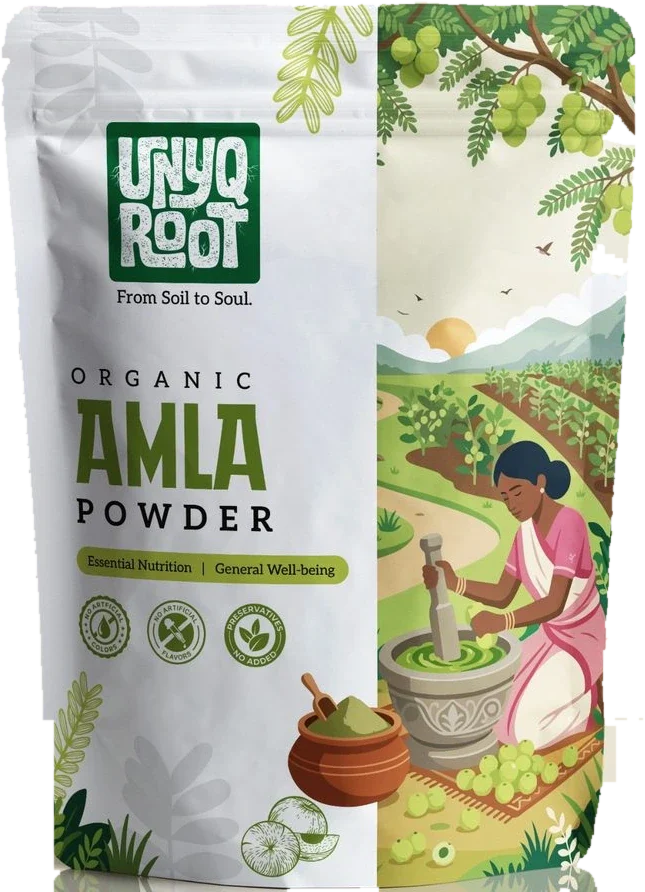
Powder is the most flexible form, and a clean single-ingredient amla churna such as UNYQROOT's amla makes it easy to control your own dose and pair it with water, honey, or warm milk as the season suggests.
Fresh fruit, juice, and traditional preparations
- Fresh amla: when in season, one fruit a day, eaten plain, grated into salads, or lightly salted, is a simple habit. Some prefer it with a pinch of rock salt to balance the sourness.
- Amla juice: about 15 to 20 ml diluted in water, once daily, usually in the morning. Dilution matters because undiluted juice is very sour and can feel harsh on sensitive stomachs.
- Chyawanprash: 1 teaspoon once or twice a day, often with warm milk, is a traditional winter routine for immunity support, especially welcome from October through February.
- Triphala: where amla appears alongside haritaki and bibhitaki, typically taken at night to support overnight digestion and morning regularity.
A practical tip for the sour-averse: a teaspoon of amla powder whisked into warm milk with a touch of honey before bed is gentler than water and pairs the fruit's nourishing side with a calming evening ritual.
When to take amla through the year
Ayurveda pays close attention to season, and amla suits this thinking well. Its cooling nature makes it especially welcome in the hot months and through the late-summer transition, when excess heat and acidity are common complaints. In winter, its immunity-supporting side comes to the front, which is why Chyawanprash and amla-rich tonics are traditional cold-weather staples. In short, amla has a sensible place in the rotation across most of the year, with the emphasis shifting from cooling in summer to nourishing in winter.
Morning is the most common time for plain amla, taken on a light stomach so the body can use it before the day's meals. Triphala and milk-based preparations lean toward evening. There is no single correct schedule; the better question is which slot you will actually keep to every day, because consistency is where amla earns its reputation.
Safety, sensible limits, and who should be cautious
Amla is a food first and is well tolerated by most people at the modest amounts described here. Still, a few points are worth keeping in mind so you use it comfortably.
- More is not better. Very large amounts of a sour, fibre-rich fruit can cause loose stools, gas, or transient acidity in sensitive individuals. Stay within food-herb doses and build up slowly.
- Its cooling, astringent nature can feel drying for some during cold, dry weather; pairing it with milk or honey helps offset that.
- If you take amla powder or juice on an empty stomach and notice discomfort, move it to mealtimes and reduce the dose.
- Buy from a source that tests for purity and avoids fillers, since you are taking it daily over long periods.
Because amla is rich in vitamin C and plant compounds and can interact with how the body handles blood sugar and clotting in theory, anyone who is pregnant or nursing, managing a health condition, or taking regular medication, including blood thinners or diabetes medication, should speak with a qualified physician or Ayurvedic practitioner before adding it as a daily supplement. None of the suggestions here are intended to diagnose, treat, or cure any condition; they describe how a healthy person can support normal digestion and immunity.
A simple way to begin
If you want a starting routine that respects both digestion and immunity, keep it small and repeatable. For the first two weeks, take half a teaspoon, around 3 g, of amla powder in cool water each morning. If that sits well, gradually move toward a full teaspoon, and in the colder months add a teaspoon of Chyawanprash or amla in warm milk at night. Notice how your digestion feels and how you carry yourself through seasonal changes, and adjust from there.
That is the whole philosophy in one fruit: nothing dramatic, nothing forced, just steady daily nourishment from soil to soul. Amla does not ask much of you. It simply asks you to show up with the same small spoonful each day and lets time do the rest.
Amla को अपनी दिनचर्या में शामिल करें
उत्पाद देखेंअक्सर पूछे जाने वाले प्रश्न
Morning on a relatively empty stomach is traditional and suits most people for digestion support. If the sourness causes discomfort or mild acidity, take it with a meal or in warm milk instead. Both work; choose whichever you can do consistently.